
Water Damage Drywall Repair in Mount Dora, FL
Water finds drywall before it finds you. A stain on the ceiling, a soft patch near a baseboard, or tape lifting along a seam is usually the first visible sign of something that started days or weeks earlier somewhere you cannot see. Mount Dora Drywall Pros repairs water-damaged drywall in homes and commercial buildings across Mount Dora and Lake County, dealing with roof leaks, plumbing failures, air conditioning condensation, appliance overflows, and storm-driven water intrusion. The damage you can see is almost never the full extent of it, which is why the first job is working out how far the water traveled.
Gypsum board absorbs and wicks moisture, moving it sideways and upward through the sheet well beyond the visible stain. Board that has been wet loses strength permanently, even after it dries and looks acceptable again, and the cavity behind it holds moisture in insulation and framing long after the surface feels dry to the touch. Covering that up with paint or a quick patch is how a small problem becomes a recurring one. We assess the extent properly, make sure the source has been dealt with and the cavity is dry before anything closes, and replace what needs replacing rather than skimming over it. Send photos of what you are seeing and request a quote, and we will tell you what you are likely dealing with.
Get a FREE Quote.
Water Damage Drywall FAQs in Mount Dora
My ceiling has a stain but it feels dry. Does the drywall still need replacing?
Possibly, and it depends on what caused it and how much water passed through. Board that has been thoroughly wet loses strength permanently, so even once it dries it may be soft, sagging, or no longer holding fasteners properly. A light stain from a brief, small leak can sometimes be sealed and painted. Repeated wetting, sagging, or a soft face means replacement. We check the board condition and the cavity behind it rather than judging by the surface, and we tell you which situation you are in.
Can you fix the drywall if the leak has not been repaired yet?
We would not recommend it, and we will not quote it as a finished repair. Replacing board while water is still entering means the new material gets wet too, usually within weeks, and you pay for the same work twice. Get the roofer, plumber, or air conditioning technician in first. Once the source is resolved and the cavity has dried, we can move quickly on the drywall side. If the damage is urgent from a safety standpoint, such as a sagging ceiling, we can discuss making it safe in the meantime.
How do I know if there is mold behind the wall?
Common indicators are a persistent musty smell, discoloration spreading beyond the original stain, and moisture that has been present for more than a couple of days. Mold can grow out of sight in insulation and on framing while the visible surface looks acceptable. We are drywall contractors, not remediation specialists, so if we open a wall and find growth beyond a small surface area, we stop and tell you rather than boarding over it. Dealing with it properly at that point is cheaper than discovering it again later.
Should I use moisture-resistant drywall in the repair?
In areas where recurrence is realistic, yes. Bathrooms, laundries, kitchens, air handler closets, and walls adjacent to plumbing are sensible candidates, and moisture-resistant board costs modestly more while giving you a better margin of safety. It is worth understanding that moisture-resistant board resists humidity and incidental moisture, it does not survive standing water or an active leak. It is a sensible upgrade in the right location, not a substitute for fixing the cause.
How long should the cavity dry before you install new drywall?
It varies with how much water was involved, how long it sat, and the conditions in the property. In Florida humidity, drying takes longer than many people expect, particularly in spaces without air conditioning running. Rather than working to a fixed number of days, we check the framing and cavity before closing and look for genuine dryness, not just a dry surface. Boarding too early traps moisture against new material and can cause staining, odor, and growth behind a wall you just paid to finish.
Will the stain come back through the new paint?
Not if the repair is primed correctly. Water staining contains dissolved minerals and tannins that bleed through ordinary paint over time, which is why a stained ceiling that has simply been painted often shows a shadow again within months. Where board is replaced the issue does not arise, and where existing stained board is being sealed rather than replaced, we use a suitable stain-blocking primer before finishing. That step is part of our scope rather than something left for the painter to discover.
What Does My Drywall Project Cost?
Drywall is priced by the square foot of wall and ceiling surface — not by the size of your floor. That one fact explains most of the gap between quotes. Here are the ranges we see on real jobs around Mount Dora, and a calculator built on the same numbers.
Drywall Repair & Patch
Most single repairs land between $250 and $800. Pros price patches by the square foot of damaged area — roughly $55–$75 a foot around Mount Dora — but every repair carries a minimum job charge, because a patch takes the same setup and the same repeat trips for drying coats whether it's the size of a dinner plate or a door. Grouping several spots into one visit is the cheapest way to fix them: they share one minimum. Some repairs are priced flat by the job instead of the square foot: a cut-out ceiling section replaced and texture-matched (an 8×10 section ran $720 flat), long seam cracks (46 linear feet of re-taped seams across three rooms ran $540 flat), and popcorn removal finished smooth (230 sq ft ran $575 flat).
New Drywall Installation
For bare studs finished paint-ready (a standard Level 4 finish), plan on $1.60–$3.00 per sq ft of wall and ceiling surface, materials and labor included. A typical 12×12 bedroom with 8-foot ceilings — that's 528 sq ft of surface — runs about $890–$1,670 around Mount Dora.
Room Remodel & Replacement
Tearing out old drywall and hauling it off adds $0.60–$1.25 per sq ft on top of new installation — a combined $2.20–$4.25 per sq ft. That same 12×12 bedroom, gutted and re-drywalled, runs about $1,210–$2,330. Opening walls can uncover surprises — water damage, old wiring — and those get priced once they're visible, never guessed at in advance.
Garage Drywall
Garages run $1.55–$3.30 per sq ft depending on finish. Code requires 5/8-inch fire-rated (Type X) board on the wall shared with the house, and on the ceiling when there's living space above it — that's the fire separation, not an upsell. Most two-car garages land between $1,900 and $4,100 finished.
Texture, Skim & Paint
On walls that are already up: skim coating runs $0.95–$1.30 per sq ft, orange-peel or knockdown texture $0.80–$1.85, and primer plus two coats of paint $1.05–$2.85. A typical room's walls — about 415 sq ft of surface — usually land between $770 and $1,960 for texture and paint together.
What Moves the Price
- Finish level. A full Level 5 skim coat (for gloss paint or bright, raking light) costs more than standard paint-ready Level 4.
- Ceilings. Overhead work runs roughly 20–25% more than the same area on a wall — lifts, heavier board, two sets of hands.
- Ceiling height. Taller walls mean longer sheets, scaffolding, and slower work.
- Texture matching. Blending a patch into existing orange peel or knockdown is hand work, and it's priced like it.
- Tear-out. Removing old drywall and disposing of it is its own line on the quote.
- Job size. Small jobs carry a minimum charge; on big jobs the setup spreads over more feet, so the per-foot price drops.
These are planning ranges, not a quote — your final price is confirmed after an in-person look, before any work starts.
A note on materials. These ranges are figured with standard drywall board and the finish level you pick above. Board isn't all the same price, though: moisture- and mold-resistant board — the green or purple board for bathrooms and basements — costs more a sheet than standard board, and on a big job that can push you toward the top of your range, or a little past it. Tell us where the work is and we'll confirm the exact board and the price at the in-person estimate, before any work starts.
Estimate Your Project
Measure the damaged section itself — length × width. A full 4×8 sheet section is 32 sq ft.
Spots done in one visit share a single minimum charge.
Price includes tearing out the old drywall and hauling it off.
Includes 5/8″ Type X fire-rated board on the wall shared with the house — and on the ceiling when there is living space above it — as code requires.
Free — no obligation. Your calculator numbers ride along with the request.
Send Your Project to Mount Dora Drywall Pros
Your estimate is attached automatically. Add your info and — if you can — a few photos of the project. Photos help us price the job before we ever set foot in the house. Prefer to talk? Call (352) 623-5928.
Why Property Owners Trust Us With Water Damage
The value we add on water damage work is honesty about scope. It is easy to cut out the stained square, fit a patch, and collect payment, and it is also the reason so many homeowners are dealing with the same ceiling for the third time. Mount Dora Drywall Pros checks how far the moisture has actually traveled, looks at the cavity rather than just the surface, and tells you plainly if the source has not been resolved or if the framing behind the board is still wet. If a repair should wait a few days for drying, we will say so instead of rushing it to close out the job.
We also coordinate rather than overstep. Where a plumber, roofer, or air conditioning technician needs to fix the cause first, we will tell you that before quoting. Where remediation is required because moisture has been sitting for a while, we will point you in that direction rather than boarding over it. Once the space is dry and the source is handled, we handle the drywall side properly, from cutting back to sound material through to matching the surrounding texture so the repair disappears. You get containment, protection, clear scope, and documentation of what we found, which is often useful if an insurance claim is involved. Check availability and we will let you know how quickly we can assess it.

Our Water Damage Drywall Repair Services
Water damage looks different depending on where it came from and how long it ran. A sudden burst behaves differently to a slow roof leak, and a condensation problem produces damage that spreads quietly over months. Below are the water-related drywall repairs we handle most often around Mount Dora.
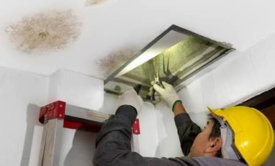
Ceiling Water Damage Repair
Cutting out and replacing stained, sagging, or softened ceiling board caused by roof leaks and overhead plumbing failures.
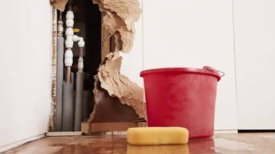
Plumbing Leak Wall Repair
Repairing wall board damaged by burst pipes, supply line failures, and slow leaks behind kitchens, bathrooms, and laundries.
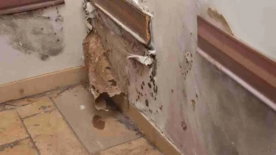
Storm and Wind-Driven Rain Damage
Replacing board affected by water entering through roofs, windows, flashing, and openings during storm season.
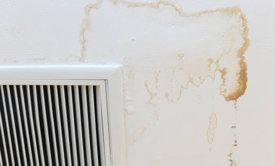
Air Conditioning and Condensation Damage
Repairing damage from condensate line overflows, sweating ductwork, and moisture around air handler closets.
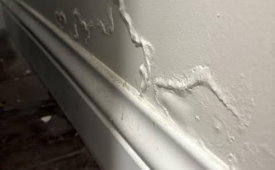
Appliance Overflow and Flood Repair
Cutting back and replacing lower wall board affected by water heater, washing machine, dishwasher, or flood damage.
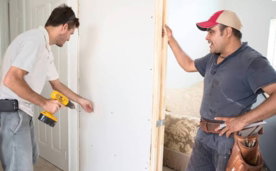
Moisture-Resistant Board Replacement
Reboarding wet areas with moisture-resistant material where the location makes recurrence a realistic risk.
Making Sure the Source and the Cavity Are Handled First
No drywall repair should start while water is still getting in. The sequence is always source first, drying second, board third, and skipping a step guarantees the repair fails. That means the roof, pipe, flashing, condensate line, or appliance has to be fixed by the appropriate trade before we schedule the drywall work. It also means the cavity needs time to dry out properly, because framing, insulation, and the back face of adjacent board hold moisture long after the surface stops feeling damp. Insulation that has been wet generally does not recover and needs removing, since leaving it in place traps moisture against the framing behind brand new board.
Timing matters more here than on any other type of drywall work, and Florida conditions make it harder rather than easier. High ambient humidity slows evaporation, so a cavity that would dry in a few days elsewhere can take longer here, particularly in spaces without air conditioning running. Where moisture has been sitting for an extended period or where there is visible mold growth, that becomes a remediation question that needs addressing before the board goes back, and we will say so rather than closing the wall. In occupied properties we contain the area, protect floors and the route out, and keep the affected material bagged rather than carried openly through the building.
Water Intrusion in Mount Dora Homes and Buildings
Local conditions produce a fairly consistent list of causes. The wet season brings heavy afternoon storms. Wind-driven rain finds its way through roof penetrations, flashing, window seals, and door thresholds, and the resulting damage usually appears as ceiling staining on the floor below or dark patches near exterior wall corners. Properties with large roof spans and older tile or shingle roofs, and buildings with many rooftop penetrations, are more exposed. Homes and commercial units in low-lying spots or with poor site drainage also see water entering at floor level during heavy rainfall, which damages the bottom of the wall board first.
Air conditioning is the other major source here. It runs year-round. Condensate line blockages, overflowing drain pans, and sweating ductwork in hot attics produce slow, persistent moisture that often damages ceilings and the walls of air handler closets before anyone notices. Older homes near the town center can have aging supply plumbing behind walls. Enclosed lanais, garages, and unconditioned back-of-house areas in commercial buildings suffer from sustained high humidity that softens board over time without any single leak event. Knowing which of these is in play changes both the extent of the repair and the board we specify going back in. We handle the same storm and leak damage in lakefront and riverfront homes in Eustis, Astatula, and DeBary.
What Affects the Cost of Water Damage Repair
The main cost driver is how far the water traveled. That is often several times larger than the visible stain. Moisture wicks through gypsum, so sound-looking board adjacent to the damage frequently has to come out too. Ceiling work costs more than wall work because of access and the difficulty of finishing overhead. Damage at height or over fixed fittings and gear adds setup time. Multiple affected areas across a property mean multiple containment and clean-down cycles, which adds labor beyond the square footage involved.
Beyond extent, the variables are condition and finish: wet insulation that needs removing and replacing, framing that needs drying or treatment, and cavities that require extra time before closing all add to the program. Specifying moisture-resistant board in a wet area costs more than standard board but is usually worth it where recurrence is plausible. Texture matching on older ceilings and walls takes extra passes. Delays for drying time mean more visits. Where an insurance claim is involved, documentation adds a small amount of admin. We inspect before quoting so the scope reflects the real extent. If the source has not been fixed yet, we will tell you before pricing the repair.
How We Handle Water-Damaged Drywall
Step 1: Inspection and Moisture Assessment
We inspect the affected area, check how far the moisture has traveled beyond the visible staining, and assess the board, insulation, and framing condition so the scope reflects the actual extent of the damage.
Step 2: Source Confirmation and Drying Check
Before quoting we confirm the cause has been fixed by the relevant trade and that the cavity is dry or on track to be. If remediation is needed first, we tell you plainly rather than scheduling around it.
Step 3: Written Scope and Documentation
You receive a clear quote covering the board to be removed, insulation replacement, the finish level, and any moisture-resistant specification. We document what we found, which helps if an insurance claim is involved.
Step 4: Containment and Material Handling
The work area is sealed, floors and the exit route are protected, and HVAC returns are isolated where required. Wet material is bagged and removed rather than carried openly through the property.
Step 5: Cut Back to Sound, Dry Material
Damaged board is cut back past the moisture line to material that is genuinely dry and sound. Affected insulation is removed, and the exposed framing and cavity are checked before anything goes back on.
Step 6: Board Replacement and Specification
New board is fitted and fastened to match the existing construction, using moisture-resistant board where the location justifies it. Backing is added wherever the cut has left an unsupported edge.
Step 7: Finishing, Texture Matching, and Priming
Joints are taped and built up in feathered coats, the surrounding texture is matched, and the repair is primed with a suitable sealing primer so no residual staining bleeds through the finish paint.
Step 8: Cleanup and Final Inspection
Debris and protection are removed and the area is cleaned. We review the finished repair with you under good light, confirming the surrounding surfaces have remained dry.
Get a Clear Quote on Your Project
The next step is a straight conversation about the space itself. Tell us what you are dealing with, send through photos or plans if you have them, and we will let you know what the work involves, how long it should take, and what it will cost. There is no obligation attached to an estimate, and we would rather spend the time getting the scope right than hand you a number that changes halfway through the job.
Mount Dora Drywall Pros works with homeowners, builders, property managers, and business owners across Mount Dora and the surrounding Lake County area. Request a quote or check availability. You will get a clear answer on timing rather than a vague callback promise. If your schedule is tight or you are coordinating around other trades, tell us upfront. We will plan the work around it.
Related Services
Drywall Repair · Drywall Patching · Drywall Ceiling Repair · Residential Drywall Repair · Drywall Replacement · Commercial Drywall Repair · Drywall Installation · Residential Drywall Installation · Commercial Drywall Installation · Garage Drywall Installation · Metal Stud Framing · Drywall Partition Installation · Fire-Rated Drywall Installation · Moisture & Mold-Resistant Drywall Installation · Soundproof & Acoustic Drywall Installation · Suspended Ceiling Installation · Drywall Finishing · Drywall Taping & Mudding · Drywall Texture Matching · Popcorn Ceiling Removal · Drywall Painting & Finishing