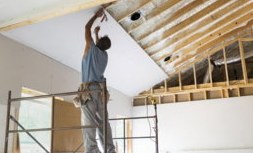
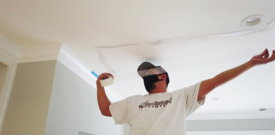
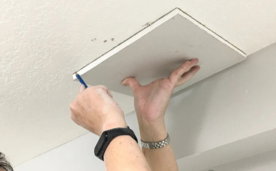
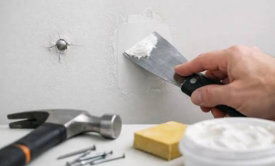
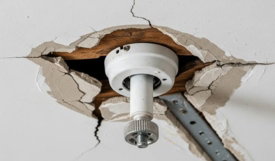
Ceilings are unforgiving. Light crosses them at a low angle from windows and fixtures, which means every dip, ridge, and repair line shows up in a way it never would on a wall. Mount Dora Drywall Pros repairs ceiling drywall in homes and commercial buildings across Mount Dora and Lake County, dealing with cracks at the wall junction, sagging panels between joists, nail pops across a whole room, and damage left behind after light fittings and fans are moved, plus holes cut for access that were never properly closed. The repair itself is rarely complicated. Making it invisible from the doorway is the part that takes skill.
Overhead work also has its own physical realities. Everything is done against gravity, compound behaves differently when it is applied upward, and the working position slows down what would be quick on a wall. A ceiling repair usually needs more coats, wider feathering, and more patience than the same size patch at eye level. Before any of that, though, we want to know why the ceiling failed. A crack that follows the wall line is telling you something different to one running across the middle of the room, and a panel sagging between trusses points to a board or fastening problem rather than an impact. Send us a photo taken from a low angle with the light across it, request a quote, and we will tell you what is actually happening up there.
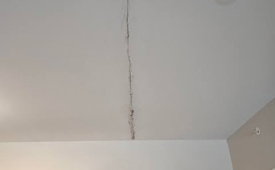
Why does the crack where my ceiling meets the wall keep coming back?
That line is usually caused by truss uplift, which is seasonal movement between the roof structure and the interior walls as attic temperature and humidity change through the year. Filling the crack with compound makes it disappear until the next cycle, then it reopens in exactly the same place. A more durable approach accommodates the movement rather than trying to lock it in place, and in some cases the right answer involves how the junction is detailed rather than how well it is filled. We look at the pattern and timing before deciding on the method.
Is a sagging ceiling dangerous?
It depends on the cause and the degree. Slight dipping between joists is often a board thickness or fastening issue and is not an immediate hazard, though it will worsen. Pronounced sagging, board pulling away from fasteners, or any sagging accompanied by staining or dampness should be treated seriously, because wet board loses strength rapidly and can fail. If you have a ceiling that is visibly bowing and damp, keep people out from underneath it and get it looked at promptly rather than waiting for a scheduled repair slot.
Can you match my existing ceiling texture?
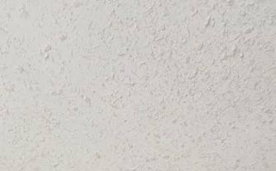
Usually, yes. Knockdown and orange peel textures are the most common locally and both can be matched closely with the right technique and timing. Hand-applied and older textures take more work, and we test the match on a sample area before committing so you are not left with a patch that reads as a different pattern. Full matching depends on how distinctive the original finish is. Where an exact match is going to be difficult, we tell you upfront and discuss options, including retexturing the full ceiling for a uniform result.
How many nail pops are too many to just repair?
Isolated pops are a straightforward repair. When they appear across an entire ceiling, it usually means widespread fastening problems rather than a few bad screws, and repairing each point individually becomes both expensive and visually patchy. At that stage refastening the ceiling comprehensively and refinishing the surface often gives a better and more durable result. We count and map them during inspection and give you our honest read on which approach makes more sense for your ceiling.
Do I need to empty the room before you start?
Not entirely, but the more that is cleared the better. Furniture that can be moved out of the room should be, and anything remaining gets covered and shifted to the center or the perimeter depending on where we are working. Ceiling repairs generate more dust than wall repairs because sanding is overhead, so we also cover floors and seal the work area. Let us know about anything fragile, fixed, or difficult to move before the visit and we will plan around it.
How long does a ceiling repair take from start to finish?
Most ceiling repairs span two to three visits rather than a single day, because compound has to dry between coats. Ceiling work most times needs more coats than wall work. A small patch might be finished across two short visits. A larger repair with texture matching and priming usually runs longer. Humidity slows drying here, so we build realistic gaps into the schedule rather than forcing coats and ending up with cracking or shrinkage a few months later.
What Does My Drywall Project Cost?
Drywall is priced by the square foot of wall and ceiling surface — not by the size of your floor. That one fact explains most of the gap between quotes. Here are the ranges we see on real jobs around Mount Dora, and a calculator built on the same numbers.
Drywall Repair & Patch
Most single repairs land between $250 and $800. Pros price patches by the square foot of damaged area — roughly $55–$75 a foot around Mount Dora — but every repair carries a minimum job charge, because a patch takes the same setup and the same repeat trips for drying coats whether it's the size of a dinner plate or a door. Grouping several spots into one visit is the cheapest way to fix them: they share one minimum. Some repairs are priced flat by the job instead of the square foot: a cut-out ceiling section replaced and texture-matched (an 8×10 section ran $720 flat), long seam cracks (46 linear feet of re-taped seams across three rooms ran $540 flat), and popcorn removal finished smooth (230 sq ft ran $575 flat).
New Drywall Installation
For bare studs finished paint-ready (a standard Level 4 finish), plan on $1.60–$3.00 per sq ft of wall and ceiling surface, materials and labor included. A typical 12×12 bedroom with 8-foot ceilings — that's 528 sq ft of surface — runs about $890–$1,670 around Mount Dora.
Room Remodel & Replacement
Tearing out old drywall and hauling it off adds $0.60–$1.25 per sq ft on top of new installation — a combined $2.20–$4.25 per sq ft. That same 12×12 bedroom, gutted and re-drywalled, runs about $1,210–$2,330. Opening walls can uncover surprises — water damage, old wiring — and those get priced once they're visible, never guessed at in advance.
Garage Drywall
Garages run $1.55–$3.30 per sq ft depending on finish. Code requires 5/8-inch fire-rated (Type X) board on the wall shared with the house, and on the ceiling when there's living space above it — that's the fire separation, not an upsell. Most two-car garages land between $1,900 and $4,100 finished.
Texture, Skim & Paint
On walls that are already up: skim coating runs $0.95–$1.30 per sq ft, orange-peel or knockdown texture $0.80–$1.85, and primer plus two coats of paint $1.05–$2.85. A typical room's walls — about 415 sq ft of surface — usually land between $770 and $1,960 for texture and paint together.
What Moves the Price
Finish level. A full Level 5 skim coat (for gloss paint or bright, raking light) costs more than standard paint-ready Level 4.
Ceilings. Overhead work runs roughly 20–25% more than the same area on a wall — lifts, heavier board, two sets of hands.
Ceiling height. Taller walls mean longer sheets, scaffolding, and slower work.
Texture matching. Blending a patch into existing orange peel or knockdown is hand work, and it's priced like it.
Tear-out. Removing old drywall and disposing of it is its own line on the quote.
Job size. Small jobs carry a minimum charge; on big jobs the setup spreads over more feet, so the per-foot price drops.
These are planning ranges, not a quote — your final price is confirmed after an in-person look, before any work starts.
A note on materials. These ranges are figured with standard drywall board and the finish level you pick above. Board isn't all the same price, though: moisture- and mold-resistant board — the green or purple board for bathrooms and basements — costs more a sheet than standard board, and on a big job that can push you toward the top of your range, or a little past it. Tell us where the work is and we'll confirm the exact board and the price at the in-person estimate, before any work starts.
Estimate Your Project
Measure the damaged section itself — length × width. A full 4×8 sheet section is 32 sq ft.
Spots done in one visit share a single minimum charge.
Price includes tearing out the old drywall and hauling it off.
Includes 5/8″ Type X fire-rated board on the wall shared with the house — and on the ceiling when there is living space above it — as code requires.
Your estimated range
Free — no obligation. Your calculator numbers ride along with the request.
Send Your Project to Mount Dora Drywall Pros
Your estimate is attached automatically. Add your info and — if you can — a few photos of the project. Photos help us price the job before we ever set foot in the house. Prefer to talk? Call (352) 623-5928.
Why Mount Dora Property Owners Choose Us for Ceiling Work
Ceiling repairs are where corner-cutting becomes obvious fastest. A patch that was not feathered wide enough shows as a halo the moment the afternoon sun comes through the window, and a texture that was not matched properly reads as a bright island from every seat in the room. Mount Dora Drywall Pros builds ceiling repairs up in coats, feathers them well beyond what looks necessary while the compound is wet, and checks the result under raking light rather than standing directly beneath it where everything looks fine.
We also diagnose before we repair. If a crack keeps returning in the same line year after year, filling it again is not a fix, it is a subscription. We look at whether the cause is truss movement, an unsupported joint, a fastening issue, or moisture, and treat it accordingly. Where a ceiling is failing across a large area rather than in one spot, we will tell you honestly that replacement gives a better outcome than a dozen patches. Overhead work makes more mess than wall work, so we cover floors and furniture properly, contain the dust, and clean up at the end of each visit. Check availability and we will let you know how soon we can take a look.
Our Ceiling Repair Services
Ceiling problems fall into a few recognizable categories, and each one has a different underlying cause and a different fix. Movement cracks need the joint reinforced, sagging needs the board and fastening addressed, and access holes just need closing properly. Below are the ceiling repairs we are called out for most often around Mount Dora.
Ceiling Crack Repair
Repairing cracks across ceiling panels and along the wall junction, including reinforcing the joint so the line does not reopen.
Sagging Ceiling Panel Repair
Addressing board that has dipped between joists or trusses, correcting the fastening and replacing panels that have lost strength.
Resetting fasteners that have worked loose across a ceiling and refinishing each point so the surface reads flat again.
Light Fitting and Ceiling Fan Patching
Repairing the board where fans, downlights, and fixtures have been removed, relocated, or pulled through the ceiling.
Ceiling Texture Repair and Blending
Matching knockdown, orange peel, and hand-applied ceiling textures across a repair so the patch disappears once painted.
What Has to Be Checked Before a Ceiling Repair
Diagnosis comes first, because the same crack can have several different causes and each one needs a different response. A straight line where the ceiling meets the wall usually indicates movement between the roof structure and the walls rather than a failure of the board. A crack running across the ceiling often follows a joint that lacked support or fastening. Sagging between supports points to board that is too thin for the span, fasteners that have lost grip, or the weight of insulation sitting on top. We also check for moisture before touching anything, since staining, softness, or a musty smell means the problem is water and the source has to be resolved before any repair is worthwhile. Anything above the ceiling that is loose, wet, or improperly supported needs sorting first.
Access and protection are the practical side. Ceiling work means everything below has to be cleared or covered. We plan furniture movement, floor protection, and containment before setting up. High ceilings, stairwell voids, and vaulted spaces need staging or lifts, which changes both the setup time and the access required to get gear into the room. Occupied properties need the work zone sealed, because overhead sanding puts more dust into the air than any other drywall task. Humidity affects the schedule too, since ceiling compound dries slower overhead. Rushing the next coat onto a damp one causes the exact cracking you are trying to eliminate.
Common Ceiling Problems in Local Properties
Ceiling issues around Mount Dora follow the age and construction of the building fairly closely. Newer homes in the subdivisions tend to show truss-related cracking at the wall-to-ceiling junction within the first couple of years, along with nail pops appearing across a room as framing dries and settles. This is normal movement rather than a defect, but it needs repairing in a way that accommodates the movement instead of simply filling the line. Older properties near the town center bring different problems, including aged board fastened to framing that is no longer flat, hand-applied textures that no longer match anything current, and ceilings that have been patched repeatedly over the decades.
Climate is a constant factor overhead. Attic spaces in Lake County get extremely hot through the long summer, and the temperature difference between that space and the conditioned rooms below drives expansion and contraction right at the ceiling plane. Trusses lift and settle seasonally, which is why the same wall junction crack tends to reappear in the same month each year. Humidity in unconditioned areas such as garages, enclosed lanais, and back-of-house commercial spaces softens board and loosens fasteners over time, producing sagging rather than cracking. Storm season adds roof leaks to the list, and ceilings are almost always where that damage announces itself first. We repair the same ceiling problems in older homes across Mount Dora, Eustis, and Tavares.
What Affects the Cost of a Ceiling Repair
Height and access drive ceiling pricing more than anything else. A standard eight-foot ceiling in a cleared room is straightforward. The same repair in a two-story entry, a stairwell void, or a vaulted great room needs staging or lift gear, takes longer to set up than to execute, and requires more hands. Rooms that cannot be cleared add time for furniture protection and working around obstacles. The number of separate repair points matters as well, since a room with twenty nail pops involves twenty small finishing operations rather than one.
Finishing is the other half. Ceiling repairs generally need more coats and wider feathering than wall repairs because of how light behaves overhead, and each coat needs drying time, so most ceiling jobs involve multiple visits. Texture matching adds passes, particularly on hand-applied or aged finishes where getting the pattern right takes test sections first. Whether priming and painting are included, whether the underlying cause needs correcting before the repair, and whether damaged board is being replaced rather than patched all feed into the figure. Send a photo taken with light raking across the ceiling when you request a quote and we can size the job much more accurately.
How We Repair a Damaged Ceiling
Step 1: Photos and Damage Diagnosis
You send photos taken with light across the ceiling and describe when the problem appeared. That usually tells us whether we are dealing with movement, fastening failure, moisture, or impact before anyone visits.
Step 2: On-Site Inspection and Moisture Check
We inspect from below and check the board for softness, staining, and movement. Where access allows, we look at the space above to confirm the cause and rule out an active leak before quoting a repair.
Step 3: Written Quote and Access Planning
You receive a clear quote covering the repair method, the number of visits expected, texture matching, and whether staging or lift gear is required for the ceiling height involved.
Step 4: Room Clearing and Overhead Protection
Furniture is moved or fully covered, floors are protected, and the work zone is sealed. Overhead work creates significant dust, so containment goes up before any cutting or sanding begins.
Step 5: Cutting Back and Fastening Correction
Damaged board is cut back to sound material and solid framing, loose fasteners are reset, and backing is added where a joint was unsupported. Sagging panels are replaced rather than screwed back flat.
Step 6: Reinforcement and Joint Treatment
Cracks are opened and reinforced so the repaired joint can handle the movement that caused them. New board sections are taped and bedded with the joint properly supported behind.
Step 7: Coating, Feathering, and Texture Matching
Compound is built up in coats, each feathered wider than the last, with drying time respected between passes. The existing ceiling texture is tested and matched before being applied across the repair.
Step 8: Priming, Cleanup, and Raking Light Check
The repair is primed so paint will not flash, dust and protection are removed, and we check the finished ceiling with you under raking light rather than from directly underneath.
Get a Clear Quote on Your Project
The next step is a straight conversation about the space itself. Tell us what you are dealing with, send through photos or plans if you have them, and we will let you know what the work involves, how long it should take, and what it will cost. There is no obligation attached to an estimate, and we would rather spend the time getting the scope right than hand you a number that changes halfway through the job.
Mount Dora Drywall Pros works with homeowners, builders, property managers, and business owners across Mount Dora and the surrounding Lake County area. Request a quote or check availability. You will get a clear answer on timing rather than a vague callback promise. If your schedule is tight or you are coordinating around other trades, tell us upfront. We will plan the work around it.
Recent Project in Mount Dora, FL
Residential drywall repair in Eustis, FL
Homeowner: Ray — Eustis, FL
The problem: Hairline cracks ran along the ceiling seams in three rooms. They came back each time Ray painted over them.
What Ray told us: Ray wanted the cracks fixed for good, not just covered. He asked what kept them coming back.
Scope of work: Fixed cracked seams in three rooms — re-taped the joints, floated fresh compound, and sanded smooth for paint.
Materials and gear: Paper tape, setting compound, finish compound. Size: 3 rooms, about 46 linear ft of seams.
Final price: $540, with 1 day on site.
Cost note: Three rooms priced as one written job at $540, inside the $250 to $800 single-repair range.
Outcome: The seams are tight and smooth. A year on, Ray says the cracks have not come back.